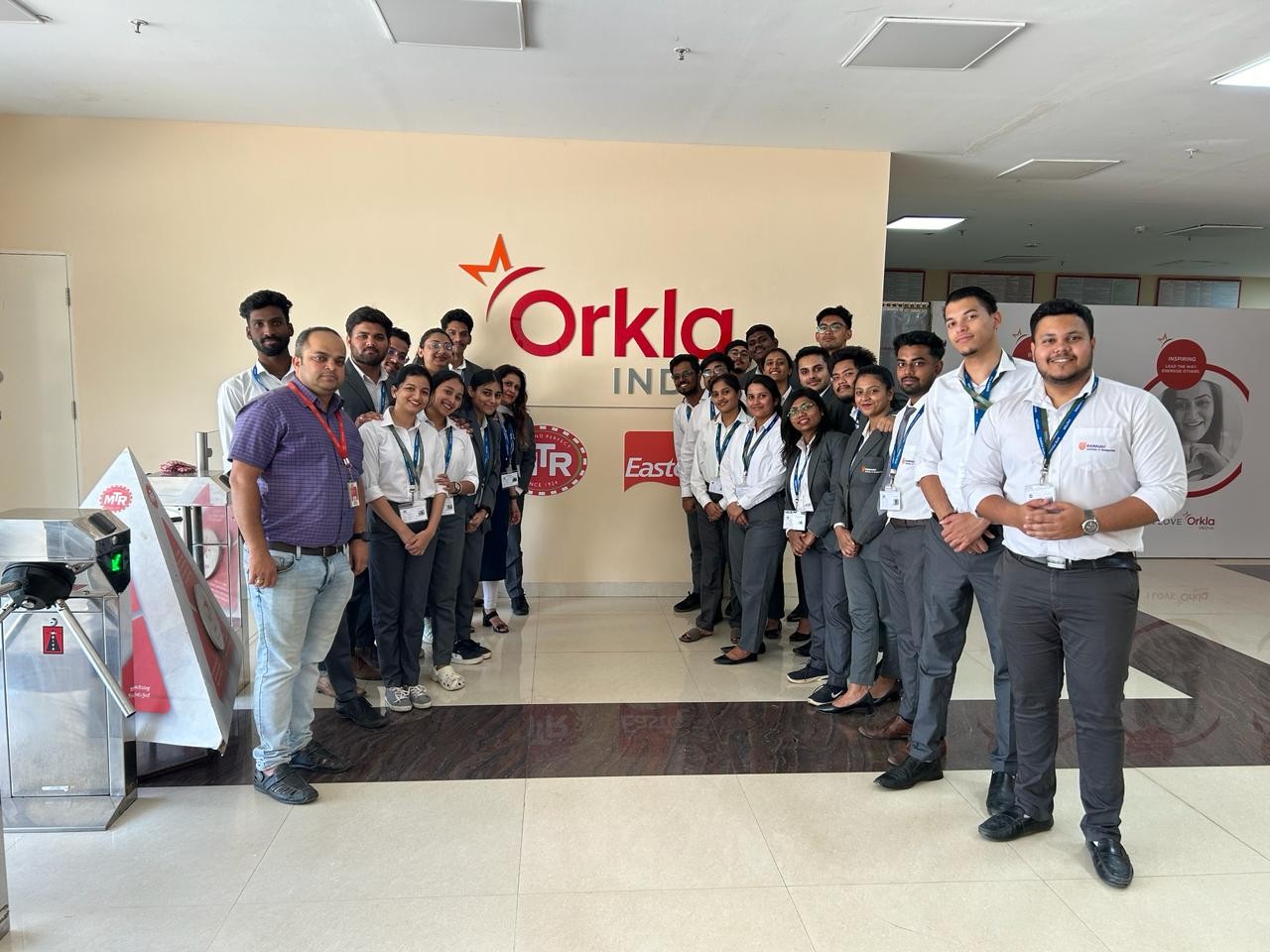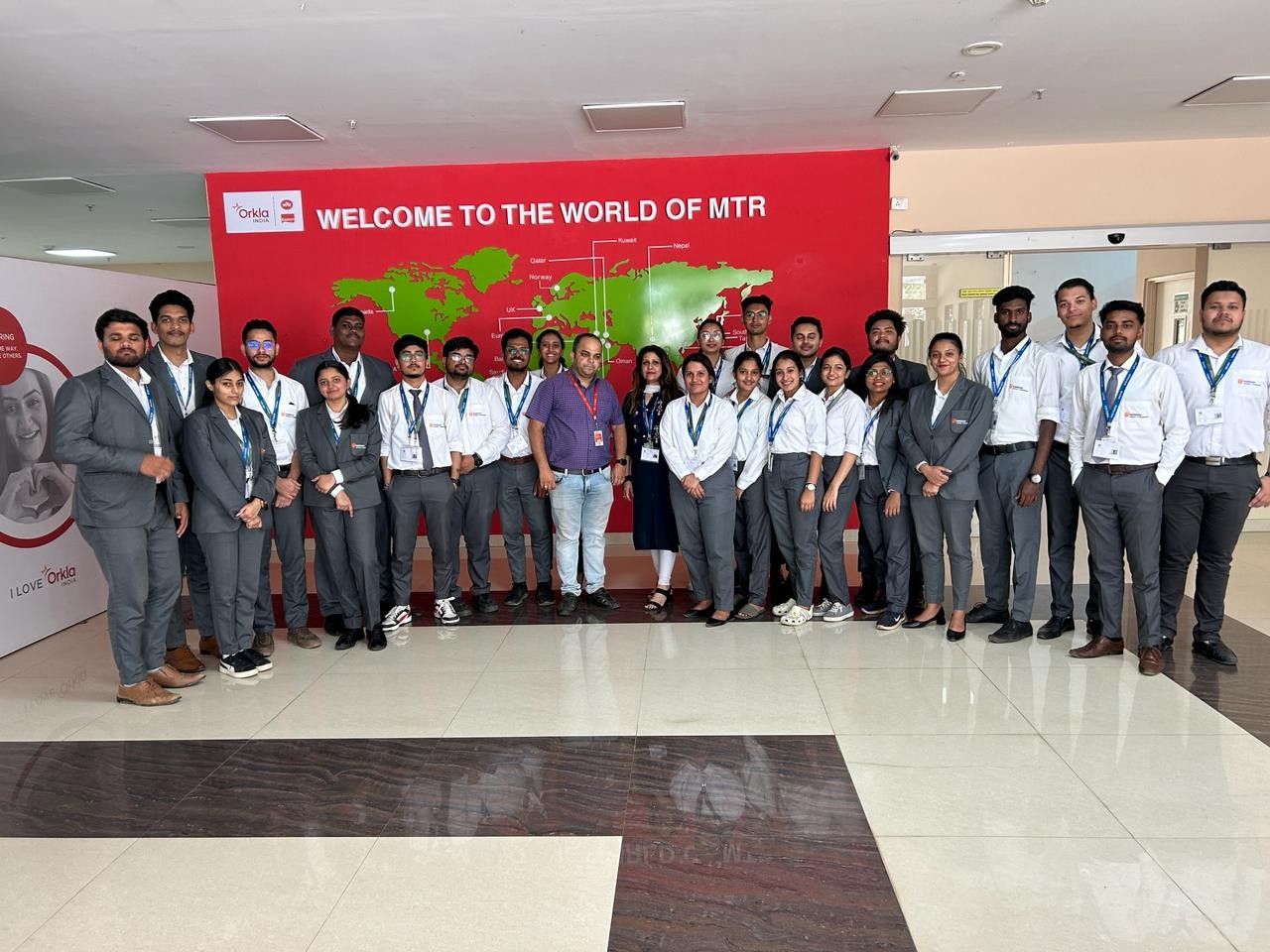
Faculty Co-ordinator: Senior Assistant Prof. Niharika Mishra
MTR Administrative Co-ordinator: Mr. Raju M L
Location: Karnataka, Bommasandra
Date:17/02/24
About the company
The tradition of food and hospitality began in 1924 with the establishment of the MTR Restaurant by the Maiya family in Bangalore. This restaurant is a city landmark today and people still stand in queue to savour its unique, completely authentic dishes.
Then in 1975, Maiyas diversified into the business of convenience foods and instant mixes. As the business expanded, modernization and state-of-art facilities, including dedicated Lab and printing and packaging facilities, were added.
MTR's wide range of products include ready-to-eat curries and rice, ready-to-eat cook gravies, frozen food, ice-cream, instant mixes, spices and variety of pickles & papads, and milk beverage drinks.
MTR has its footprints across the globe. To fuel further growth, MTR became part of Norwegian Company M/s Orkla in 2007. The company is currently a 2000 crore company.
Culinary secrets have been protected and handed down over the generations and our food is based on truly authentic recipes from their region of origin. Our journey to India's premier, processed food company has been marked by innovation and the adoption of new technology.
Precisely, every MTR product will always embody our tradition of unmatched taste, purity and quality.
VISION
Your friend in everyday life.
Brave
We continuously challenge ourselves to be Brave - to think more innovatively, to act more boldly, to be world-class. We as Brave people have aimed high and loved to win. We speak up if something is wrong.
Trustworthy
We demonstrate that we are Trustworthy people, who are professional, skilful and reliable. People can trust us. We keep our promises. We deliver.
Inspiring
We inspire. We are passionate and burn with a desire to succeed. We innovate continuously. We Inspire consumers, customers, partners and each other.
WHY MTR?
Taste the journey of lifetime
At MTR Foods, immense pride is given to the rich heritage of over 85 years. Their journey mirrors to that of our nation; a legacy forged by generations together. Right from our traditional beginnings to the 21st century technological prowess, our offerings are part of a rich Indian heritage.
With the finest ingredients, it is no wonder that we believe in adhering to our authentic recipes.
Motive is in being future-forward and matching the pace of technology to reach our fast-moving consumers. Immense emphasis is on the employee safety and health policy to produce optimum results. With their certified food and safety policy, they not only believe but also ensure that quality stands first.
ENVIRONMENT HEALTH & SAFETY POLICY
They believe that a focus on work along with Environment, Health, and Safety contributes to greater efficiency and comfort and is an essential part of their business.
They consider their work with Environment, Health, and Safety as a necessity for their long-term profitability and growth.
In collaboration, they strive to create a safe, healthy, and attractive workplace where employees feel good, feel safe, and where everyone takes responsibility.
They strive to ensure that their business activities will minimize health and safety hazards and also impact on the environment, and they will seek opportunities to improve the local environment and the communities in which they operate.
Their work regarding Environment, Health, and Safety shall be conducted proactively and in a solution oriented manner.
FOOD SAFETY POLICY
Excellence ensured - ISO:22000 and HACCP certified
At MTR, quality is a way of life. Hazard Analysis and Critical Control Point or HACCP, developed by the Codex Alimentarius Commission, is a global food safety standard. They have successfully met the stringent requirements for this certification.
Their facilities are equipped with the latest systems. They adhere to international standards across all operations: from sourcing the finest ingredients to processing and packing using cutting-edge technology. Each MTR product carries this assurance of quality and meets the high expectations their consumers have from them.

Product Line up
· Beverages
· Mixes
· Masala Powders
· Sweet Mixes
· 3 Minutes Breakfast
· Breakfast Mixes
· Ready to Cook
· Single serves
· Ready to eat
· Drinks
· Pure Spices
· Meal Mixes
· Sweets
· Pickles
The MTR products can be broadly classified into 5 categories:
· Instant Foods
· Powders
· Spices
· Masalas
· Pickles
INSTANT FOODS
There are RTC foods I.e., ready to cook foods which are processed packed.
These involve two to three or four simple steps in preparing the dish after opening the
packet. Today, there is a lot of demand in the market for such foods. It includes various
mixes such as:
· Rava Idly mix: This comes in two different packs of 200 and 500 gms.
· Karabath mix: This comes in only 200 gms.
· Raasam mix: This comes 50gms, 100gms, 200gms, 500gms.
· Dosa mix: This comes only in 200gms.
· Vada mix: This comes only in 200gms.
· Jamun mix: This comes in 100, 200, and 500gms. This is the most widely
· used instant food mix.
· Rice Idly mix: This comes 50, 100, 200 and 500gms. pack.
· Bisibelebath mix: This comes 50, 100, 200 and 500gms pack.
· Sambar mix: This comes in 50, 100,200 and 500gms pack.
· Rava Dosa mix: This comes in 500gms pack.
· Badarn Feast: This comes both in refills and in jars. Refills are of 200 and 500gms jars are of 500gms and 1 kg.
COMPETITORS
· Haldiram's
· Maiyas
· Bikanervala
· Vestige marketing
· The green snack
· Balaji wafers
Facility Overview
The manufacturing plant houses various production lines for different product categories, likely including dry mixes, wet mixes, frozen foods, and spices. Each production line will have dedicated areas for raw material storage, processing equipment, packaging, and quality control.
Key Departments
· Production: Responsible for manufacturing MTR's diverse food products, ensuring quality and hygiene standards.
· Research & Development: Develops new recipes, improves existing products, and explores innovative technologies.
· Quality Control: Monitors and maintains product quality throughout the production process.
· Packaging & Warehousing: Manages packaging materials, ensures proper product storage, and facilitates timely distribution.
Specialized Units
· Fresh Batter Unit: This unit, likely part of the MTR Fresh Factory, focuses on producing fresh idli and dosa batter, adhering to specific hygiene and freshness protocols.
· Spice Grinding Unit: This unit processes and packages various spices used in MTR products, maintaining strict quality control measures.
· Frozen Food Unit: This unit produces and packages frozen ready-to-eat meals and other frozen food items.
Production Processes
· Raw Material Sourcing: MTR sources ingredients from various suppliers, adhering to strict quality control standards.
· Ingredient Processing: Depending on the product, ingredients may undergo cleaning, grinding, mixing, roasting, or other preparatory steps.
· Formulation & Blending: Precise recipes are followed to combine ingredients in the correct proportions.
· Packaging & Labelling: Products are packaged in appropriate materials with clear and informative labeling.
· Quality Control: Products undergo rigorous quality checks throughout the process to ensure safety and consistency.
· Warehousing & Distribution: Finished products are stored and distributed to retailers and consumers.
Unique or Innovative Methods
· Freshness Focus: MTR's Fresh Factory in Bommasandra prioritizes freshness, potentially using automated processes and shorter production cycles for idli and dosa batters.
· Spices Grinding Expertise: MTR has dedicated spice processing units, likely employing advanced grinding and blending techniques to preserve aroma and flavour.
· Hygiene & Food Safety: MTR emphasizes adhering to international hygiene and food safety standards, potentially using automation and advanced sanitation measures.
Quality Assurance
ISO 22000 Certification: MTR's manufacturing facilities, including the Bommasandra plant, are ISO 22000 certified, signifying adherence to internationally recognized food safety management systems. This involves:
Hazard Analysis and Critical Control Points (HACCP): Identifying and controlling potential hazards at each stage of production to minimize contamination risks.
Prerequisite Programs: Implementing essential hygiene and sanitation practices, supplier control procedures, and maintenance protocols.
Continual Improvement: Regularly reviewing and updating quality systems to ensure ongoing effectiveness.
Quality Control Throughout the Process: Stringent quality checks are conducted at various stages, including:
Incoming Raw Material Inspection: Verifying suppliers' certifications, analysing samples for quality and safety parameters.
In-Process Checks: Monitoring production lines for adherence to recipes, hygiene standards, and process parameters.
Finished Product Testing: Conducting physical, chemical, and microbiological testing to ensure product safety and quality.
Traceability and Documentation: Maintaining comprehensive records of all ingredients, processes, and batches produced for effective recall management and quality investigation.
Employee Training: Regular training for staff on food safety practices, hygiene protocols, and quality control procedures.
Technology and Innovation
· Automated Production Lines: MTR might utilize automated equipment for tasks like ingredient handling, mixing, packaging, and labelling, improving efficiency and consistency.
· Robotics and Cobots: Collaborative robots could assist with tasks like palletizing, quality control checks, and material handling, enhancing precision and worker safety.
· Process Automation and Control Systems: Computerized systems might control and monitor production processes, ensuring adherence to recipes, hygiene standards, and quality parameters.
· Data Analytics and Machine Learning: MTR could leverage data analysis to optimize production processes, predict maintenance needs, and identify quality control issues proactively.
· Advanced Imaging and Sensor Technology: These technologies could be used for real-time quality inspection, contaminant detection, and process monitoring.
MTR's Focus on Innovation
MTR emphasizes research and development, potentially exploring new technologies to improve product quality, safety, and sustainability.
They might participate in industry collaborations and partnerships to access cutting-edge technologies and solutions.
Environmental Sustainability
Resource Management: Minimizing water and energy consumption through efficient equipment and processes.
Waste Reduction and Recycling: Implementing waste reduction strategies and recycling programs for packaging materials and other waste.
Renewable Energy Exploration: Exploring the use of renewable energy sources like solar power in their facilities.
Sustainable Packaging: Utilizing eco-friendly packaging materials and reducing overall packaging usage.
Safety Protocols and Practices
MTR likely adheres to stringent safety protocols at all their facilities, including the Bommasandra plant, focusing on:
Employee Safety: Providing employees with proper training, personal protective equipment (PPE), and safety procedures to prevent accidents and injuries.
Food Safety: Implementing HACCP principles and stringent hygiene practices throughout production to ensure food safety for consumers.
Fire Safety: Maintaining fire prevention and emergency response protocols in place.
Environmental Safety: Managing hazardous materials responsibly and complying with environmental regulations.
Empowerment through Well-being and Support
Positive and inclusive work culture: MTR might promote a culture of respect, diversity, and inclusion, where employees feel valued and heard, regardless of their background or position.
Work-life balance initiatives: Flexible work arrangements, parental leave policies, and employee assistance programs could be offered to support employees in managing their personal and professional commitments.
Health and wellness programs: MTR could offer health insurance, on-site wellness programs, or other initiatives to promote physical and mental well-being among employees.
Interaction with Company Representatives
After the General manager explained us the entire history of the company and how it emerged to be a 2000 crore company today. We got an overview of how the company transformed itself after being acquired by Orkla and how the culture of the organization shifted. We got to understand how Orkla operates in India and what were the decisions that made MTR such a huge brand today.
We were also taught about how MTR in the 70s encountered sustainability issues due to food rates being reduced comprehensively which made it very difficult for MTR to continue with their restaurant business and other products, thereby leading them to come up with the innovative idea of coming up with the concept of Rava idlli, which was a packaged item and this helped them in combating with the price norms set by the government at that period of time.
We had discussed on several other aspects such as:
· The company’s future expansion
· How are they differentiating themselves from their competitors etc.
· What are the company’s best-selling items
· How Orkla as parent company of MTR operates in India with the concept of pure veg products. For example, LABAN which in other countries has ingredients which are not completely veg but in India is operating with pure veg ingredients.
· Which are the specific item which MTR is exports in the foreign countries
· Which are the countries where Orkla has its manufacturing plants.
· The idea behind Orkla acquiring Eastern which is dominant player in Kerela and the Middle East. It is given them the advantage of the distribution channel of Eastern as they have a very strong distribution network for exports especially in Kerela and Middle Eastern countries.
After the presentation about the company, we then taken to manufacturing blocks where we could get a live demonstration of how each and every product of MTR is manufactured and the processed and technologies used. We were appointed with a guide who had been providing us with each and every minute details which are involved in the production processes. It was clearly visible how MTR is focused in creating the best and most hygienic products for the market.
MTR focuses more in manufacturing most of the items by themselves instead of outsourcing it from other vendors. But there are few items like the cans used for the flavoured milk is outsourced, similarly there are certain items which they outsource it from other vendors and this is done especially for items which are not produced in everyday basis, they are usually manufactured for one week or two weeks in a month. The scalability factor and the demand factor is what matters when it comes to outsourcing or making the package in house.
We were able to visit the